

As an Amazon Associate I earn from qualifying purchases. RootLumen is a participant in the Amazon Services LLC Associates Program, an affiliate advertising program designed to provide a means for sites to earn advertising fees by advertising and linking to Amazon.com.
Roots circling a pot do not automatically require the largest container that fits the shelf. Excess unused mix can stay wet longer than the established root system can manage.
Repot because the root zone, water behavior, stability, or medium has become limiting—not because a calendar says spring and a bigger pot looks generous.
Species differ in root sensitivity, preferred medium, and tolerance of root work. Wear protection around irritating sap or soil amendments and use plant-specific guidance for rare or valuable specimens.
Confirm the root zone is the problem
Fast drying, stalled growth, instability, and roots at holes can suggest congestion but also reflect light, pests, or degraded mix. The distinction matters because the visible symptom is often one step removed from the cause. Start with the mechanism and the rest of the decision becomes easier to audit.
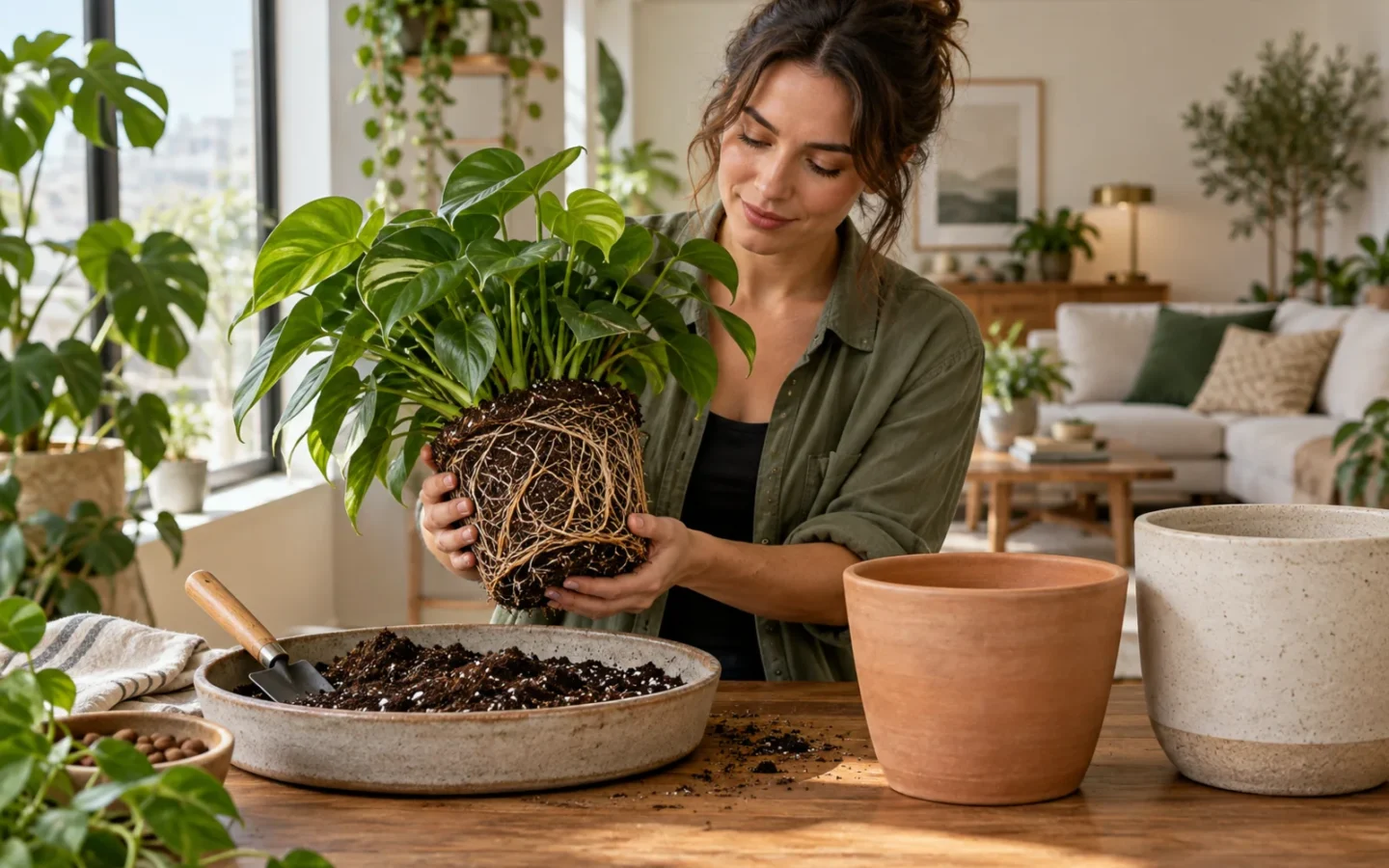
Slide the plant out when the medium is at a manageable moisture level and inspect the complete root ball. Change one variable at a time and keep the first pass conservative. That gives you a comparison point and makes it easier to reverse course before damage or frustration compounds.
Healthy dense roots support repotting; dark mushy roots and odor require a different recovery plan. If that signal moves in the wrong direction, stop and return to the last known-good state. More product, pressure, height, heat, or time is rarely the best first correction.
Increase diameter modestly
A small step adds fresh medium around active roots without surrounding them with a large slow-drying reservoir. Treat this as a system rather than a shopping problem. Size, placement, material, routine, and the person or animal using it can all change what “good” looks like.
Measure the old interior and select the next size appropriate to species and root mass, not the decorative cover pot. Prepare the entire path before starting: the work area, the tools, the cleanup, and the place where the item goes next. Interruptions are when shortcuts usually enter the process.
If the root ball occupies only a small island in the new pot, the jump is probably too large. Judge the result after the system has settled, not only in the first few seconds. Early improvement can hide wobble, residue, fatigue, crowding, or a maintenance burden.
Protect roots during release
Pulling by stems or tearing dry compacted roots can convert a routine repot into a major stress event. A useful recommendation has a boundary. It should explain not only why an approach works, but also the conditions that make another approach more sensible.
Support the root ball, flex or tap the container, and cut a disposable pot when release would otherwise require force. Use the least aggressive method that can answer the question. Escalation should follow evidence from a small test, not impatience with the first minute of work.
Stop when stems strain or the root mass begins to split unexpectedly. Use the check as a decision gate: continue only when the basic condition is stable. Otherwise, change the setup before buying an accessory meant to compensate for it.
Loosen only what needs loosening
Tightly circling roots may need gentle redirection, while aggressive teasing removes fine absorptive roots. This is where small constraints deserve more attention than headline specifications. The limiting detail is often access, clearance, stability, cleanup, or repeatability.
Work the outer layer with fingers or a clean tool according to species tolerance and remove only dead damaged material. Write down the measurement or take a reference photo when memory would otherwise decide. A repeatable check is more useful than a confident impression.
Living firm roots are preserved even when the final ball is not photographically neat. Do not average away an outlier that affects safety or comfort. One blocked exit, sharp edge, unstable joint, hot spot, or persistent mark can outweigh several convenient features.
Match medium and drainage to the plant
A pot with holes cannot compensate for a water-retentive mix that conflicts with the roots and home conditions. The goal is not maximum intensity. It is a result that can be repeated without creating a second problem somewhere else in the routine.
Use a suitable fresh medium, keep the crown at its prior depth, and eliminate large air gaps without compressing everything solid. Build the routine around the difficult moment, not the ideal one. If a step is awkward when the room is busy or the item is wet, redesign that step now.
Water should enter evenly and exit the drainage path without the plant sinking deeply. The best result is usually boring: predictable, easy to maintain, and clear about when it needs attention again. Novelty is not a substitute for control.
Stabilize aftercare instead of fertilizing immediately
Repotting changes moisture distribution and root contact, so more variables make the response harder to read. Good setup removes guesswork before it adds equipment. A clear baseline makes later changes legible instead of turning every adjustment into a new experiment.
Return the plant to stable appropriate light and follow species-specific watering and fertilizer timing. Leave enough time to inspect the result under ordinary conditions. A setup that only looks right during installation has not yet passed a useful test.
Monitor leaf loss, stem stability, and drying pattern before making another major change. When the evidence stays ambiguous, pause. A different tool, a professional assessment, or simply more observation may be cheaper than forcing a conclusion.
Record the baseline before changing more
Keep a short note of the starting condition, the exact setup, the order of work, and the first result you could verify. Include measurements, product dilution or settings when relevant, and a photograph taken from the same position and light. The note does not need to become a project log; it only needs enough detail to separate a real improvement from a change in memory, angle, weather, or expectation.
Set the next inspection by use and condition rather than an arbitrary urge to intervene. A stable setup may need only cleaning and a quick check, while a new noise, mark, wobble, odor, leak, behavior change, or loss of performance deserves an earlier look. Maintenance is most useful when it catches a small drift before the remedy becomes more aggressive than the original job.
Use the result to narrow the buying decision
Translate the successful setup into requirements before comparing listings. Write down the usable dimensions, material limits, access needed for cleaning, compatible consumables, and the one or two features that solved the original problem. Separate those requirements from conveniences and decorative details. This prevents a long feature list from displacing the physical constraint that made the equipment useful in the first place, and it gives you a direct reason to reject a product that cannot fit the routine.
Consider ownership after the first week as seriously as the unboxing. Check whether wear parts are available, whether the item can be disassembled without damage, where it will dry or be stored, and how failure becomes visible. Read the current manual and dimensions for the exact model because names and bundles can remain similar while specifications change. A slightly simpler product that can be inspected, cleaned, and used consistently is often the more durable recommendation.
When two options meet the basic requirements, compare the downside you would actually have to manage: extra floor area, a slower cleanup, recurring filters, a louder motor, more supervision, or a surface that wears sooner. Do not invent precision by ranking features that have no effect on this use case. The recommendation should remain conditional and easy to revisit when the space, user, animal, material, or routine changes.
Before committing to a purchase, verify the current model number, included parts, dimensions, warranty, return terms, and the latest manufacturer instructions. Marketplace titles and bundles change, so a familiar product name is not proof that a listing contains the same version described here. Keep the recommendation tied to the requirement it solves, and reject substitutions that remove a safety, fit, cleaning, or compatibility feature your setup depends on.
Recheck the setup after several ordinary uses. Look for the friction that appears only during cleanup, storage, refilling, charging, adjustment, or handoff to another person. If the routine consistently invites a shortcut, change the arrangement before adding more equipment. Long-term value comes from a tool remaining understandable and maintainable when the initial enthusiasm is gone.
A practical check before you finish
- Root condition is inspected before sizing up.
- New pot is only a justified step larger.
- Container release does not pull stems.
- Living roots receive minimal necessary disturbance.
- Medium and drainage match the species.
- Aftercare keeps light and inputs stable.
A product that fits this approach
A lightweight nursery-style planter with real drainage is useful as an inner working pot when the selected diameter is only a modest increase.
The HC Companies Eclipse Plastic Planter with Drainage
Why we picked it
- Multiple common sizes support measured step-ups
- Lightweight body is easy to lift for weight checks
- Drainage can sit inside a decorative cachepot
Reported drawbacks
- Plastic appearance may need a cover pot
- Saucer water still must be emptied
- Exact drainage layout varies by size
The useful stopping point
A good repot gives roots a little more usable room and a medium you can manage. The plant should leave the process stable, not lost in a volume of wet mix chosen for future ambition.